

When the Plan Changes
How a developer captured the value of a consented site without undertaking the development
The client situation
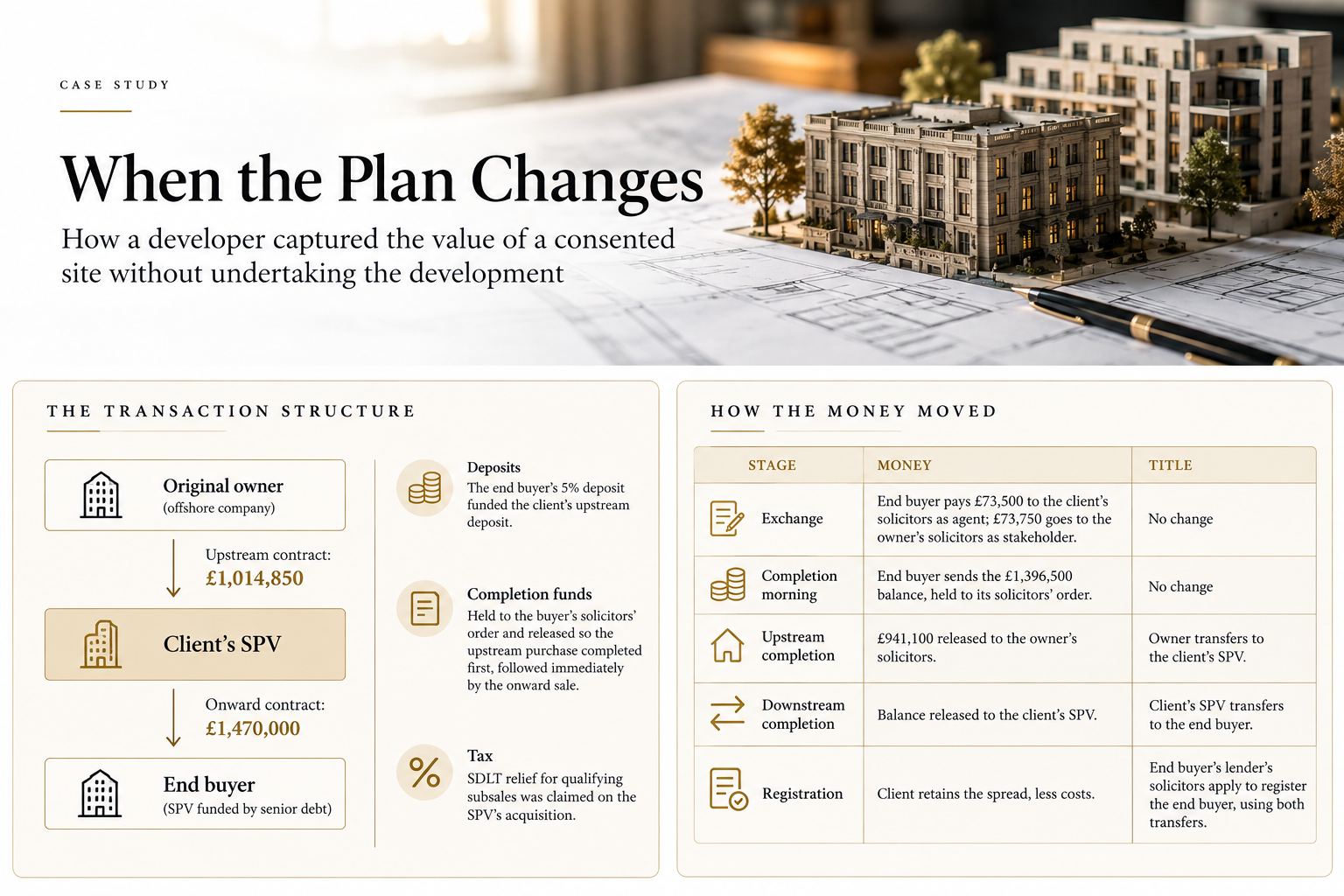
The client identified two adjoining office buildings with a poor energy rating and limited appeal as an office investment. It saw a residential conversion opportunity and pursued it before securing the site.
Over roughly eighteen months it spent around £100,000 on planning and pre-contract work, without an exchanged contract or an option. By the time the purchase was ready to proceed, much of the site's development value had already been created by work the client had funded while it had no binding right to acquire.
That is an unusual position. The client had generated value it did not yet own, and the question was how best to realise it.
When the original plan stopped being the best plan
The original plan was conventional and, when conceived, sensible: acquire with bridging finance, refinance onto development finance, convert and sell the units.
The acquisition then slowed. The owner was a British Virgin Islands company, which brought a BVI legal opinion, certificates of good standing and heavier anti-money laundering checks on both sides. The title carried a restriction in favour of a dissolved management company and surrendered leases still noted on the register, with the owner's applications to clear them pending at HM Land Registry. Each issue required undertakings to be negotiated so that buyers and lenders could proceed.
None of this was fatal. Together it cost time, and time changed the economics. Holding exposure grew, the development timetable stretched and the client's confidence in the original funding route weakened.
The building had not changed. The assumptions behind the strategy had. The useful question at that point was not how to rescue the original plan, but this: given what we now know, is acquiring and developing still the best way to capture the value already created?
The pivot: realise the value, don't build it
The client decided to sell the consented opportunity rather than develop it. Other routes were briefly considered and discounted as more complicated.
Commercially, this was a reallocation of risk rather than a retreat. The client had already completed the stage that had created much of the underlying value. What remained, construction, development debt and unit sales, carried risk it no longer needed to take to realise most of the return. Planning had created much of the underlying value. The task now was to structure a transaction that let the client capture it without undertaking the development.
That meant turning a commercial decision into something executable: a buyer bound at the right price, the client protected against its own seller, and the two transactions sequenced so that one could fund the other.
The transaction structure
The structure was a back-to-back sale using two separate contracts, both exchanged on 25 November 2025.
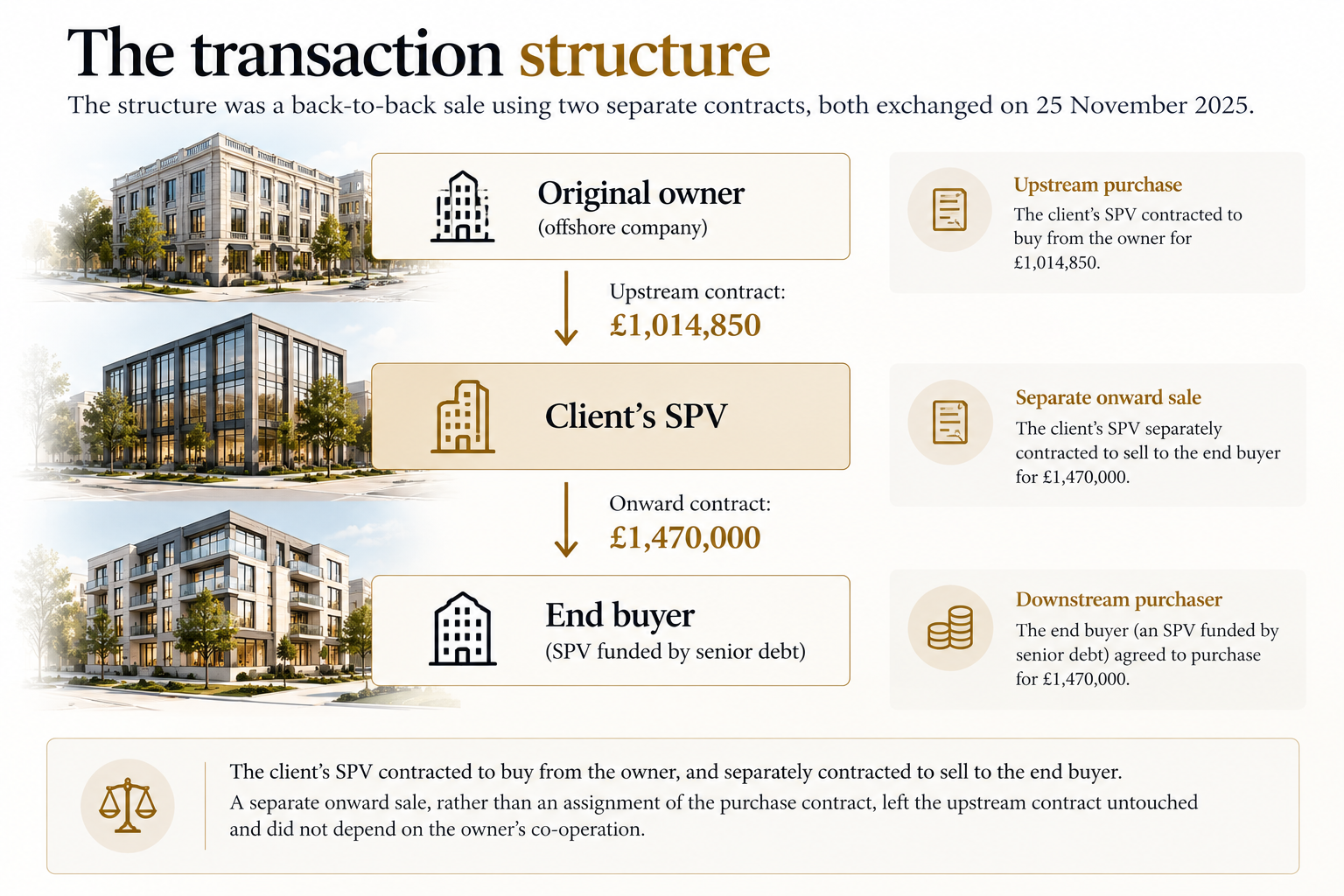
Three elements made it work financially:
Deposits. The end buyer's 5% deposit was held as agent for the client's SPV, and was almost exactly the size of the SPV's own upstream deposit. Economically, the buyer's deposit funded the client's.
Completion funds. The end buyer's completion money was to be held to its solicitors' order and released so that the upstream purchase completed first and the onward sale immediately afterwards. Very little of the client's own acquisition capital was needed.
Tax. Stamp duty land tax relief for qualifying subsales, under Schedule 2A to the Finance Act 2003, was claimed on the SPV's acquisition, so the intermediate step did not carry a second SDLT charge.
Sequencing was the commercial heart of the structure. The client would be bound to pay its seller whether or not the end buyer paid on time. How the two transactions related in time mattered as much as what either contract said.
The risk control that mattered most: time
The onward sale was set to complete on 20 January 2026. The upstream purchase was set to complete on 16 February 2026, with the client's SPV able to complete earlier on notice.
That 27-day gap was deliberate. It was Tariq Mubarak's advice, as a hedge against exactly one risk: that the end buyer might not be ready on time.
If the end buyer completed on schedule, the client could call for early completion upstream and both transactions would complete together.
If it did not, the client would not be in default to its own seller on the same day.
Completion dates are usually treated as diary entries, negotiated around availability. In a structure where one party's money funds another's obligation, they are risk allocation. Here, the protection that mattered most was not a remedies clause. It was the gap between two dates.
When the structure was tested
The end buyer's original funding failed. It asked for more time the day before completion and did not complete on 20 January.
The client's position changed immediately. Before exchange it could have walked away. After exchange it was bound to pay its seller £941,100, and the money it had expected to use was not coming on the date it was due. The owner later declined to give the client more time.
The weeks that followed involved a notice to complete, a dispute about the effect of the contract, negotiations over revised terms and contingency planning. Throughout, the end buyer's position depended on its new lender. That lender required a refreshed BVI opinion and sight of the full upstream contract before funding, and received both.
The buffer did its job. Because the client's own completion date was 16 February, the buyer's delay did not put the client in default upstream, and the owner's refusal to extend never bit. The buyer's default cost the client time and effort, not its position.
A contingency was also in place. The client and its broker had prepared standby bridge finance, and the prospective lender's legal requirements were already in hand. It was never drawn, and there is no evidence it influenced the buyer. What it gave the client was an answer to the question every capital-light structure eventually faces: what happens if the other party's money does not arrive?
What capital-light did and did not do
It would be easy to describe this as a deal that needed no money. That would misstate the economics. The structure changed the client's risk; it did not remove it.
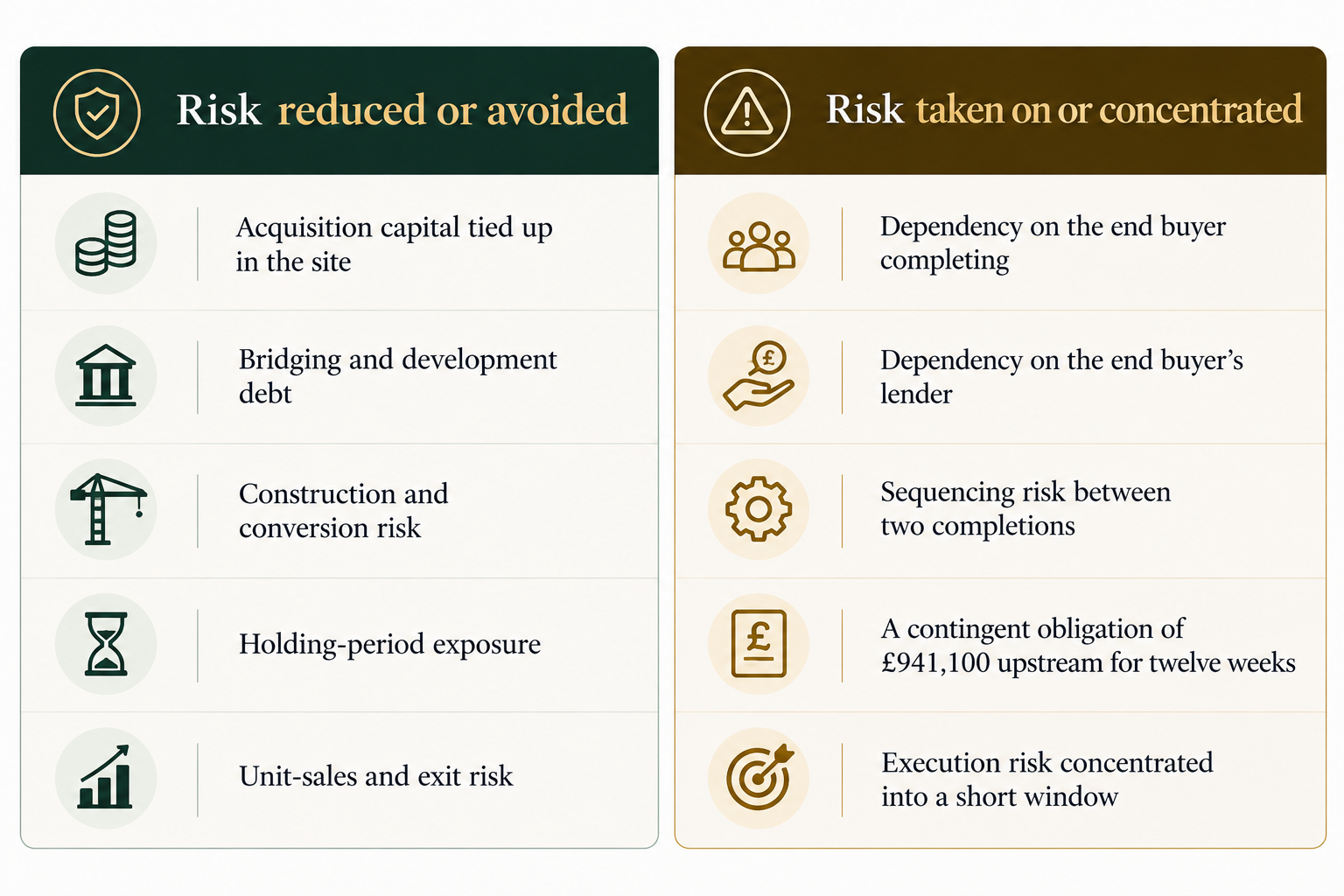
The left-hand column is why the structure was attractive. The right-hand column is why the dates, the deposits and the fallback mattered. Even at exchange, the owner required its contract to be exchanged first; for a little under two hours the client was bound to buy with no buyer yet bound to it, covered by backup funds the client had prepared.
Outcome
The end buyer secured replacement funding. Both transactions completed on 16 February 2026, on the original onward contract and at the original price.
The buyer also paid contractual late-completion interest of £9,373.77 for the delay, together with the £810 cost of the owner's BVI authority, which the contract had passed down the chain.
The contractual spread was £455,150. After agents' commissions and the sale legal fee, the client received a little under £395,000 at completion. That figure is before the roughly £100,000 of earlier planning and pre-contract expenditure, other costs and tax. It is not the same as net profit, but it is a substantial return captured without the client undertaking the development.
STM's role
The client found the site, created the planning value and decided to sell. The buyer was introduced through the selling agents. The work described here was about making that decision executable and keeping it intact under pressure:
Structure: translating the onward-sale strategy into two executable contracts, with deposits and completion funds arranged so that one transaction could fund the other.
Sequence: structuring exchange and completion, including advising on the deliberate 27-day completion buffer.
Resolve: working through the offshore-owner, title, registration and undertaking issues with the owner's solicitors, and meeting the end buyer's lender's requirements, including disclosure of the upstream contract.
Protect: managing the downstream default, through the notice and the negotiations, while preserving the client's position against its own seller through to completion.
Contingency: advising on standby bridge finance, prepared by the client and its broker, as an alternative route to completion if the downstream money did not arrive.
Commercial lessons
Value can precede ownership. Much of the value here was created by planning work carried out before the client had any binding right to buy. Consents, information and resolved problems create value as surely as ownership does.
Creating value and capturing value are different jobs. Planning created the uplift. The transaction structure captured it. Investors who conflate the two tend to reach for structures where there is nothing underneath to capture.
Re-test the strategy when the assumptions move. The original plan was sound when made. Delay, funding uncertainty and complexity changed its risk-reward balance without anything going wrong in the ordinary sense. A strategy should not survive simply because it came first.
Capital efficiency changes the composition of risk; it does not eliminate it. Less capital and no development exposure were bought with dependency on a buyer, its lender and the sequencing between them.
Time can be part of the transaction architecture. A deliberate gap between completion dates absorbed a buyer default that would otherwise have landed on the client the same day.
Stress-test non-performance before exchange. Every document works on the assumption that everyone pays on time. The questions worth asking beforehand are who fails, when, and what happens next, including whether there is a credible fallback if the money does not arrive.
For a deeper practitioner analysis of what happened when the end buyer's funding failed, including the legal and structural weaknesses the transaction exposed and what Tariq Mubarak would structure differently next time, read The Money That Was Supposed to Arrive on tariqmubarak.com.
Facing a transaction where the original plan no longer fits?
STM Consultancy works with property investors, developers, family offices and other principals on transactions where property strategy, legal structure, finance and execution meet. Typically that is when a project has moved on from the plan it started with: timing has slipped, funding has changed, or the best route to the value is no longer the obvious one.
The most useful time to test an alternative structure is before the next commitment is made. If a property project has moved beyond the assumptions on which it started, STM Consultancy can help assess the available routes, their economics and where the risk actually sits
Anonymised; figures reproduced with the client's consent. Legal services on this transaction were provided by Tariq Mubarak, solicitor, through a regulated law firm. STM Consultancy provides strategic and commercial advisory services and is not itself a law firm.